

You have a story to tell. A story that will be part of a business presentation. There are libraries full of books on how to craft the perfect story, but who has the time to read them.
But staring at the blank page with no sense of direction is a recipe for frustration.
Let me help you get a story crafted quickly. Your task is to find a rough story shape and embrace any short term messiness!
You are to sketch a basic diagram of your story. Take a sheet of A4 paper (I grab from the printer which sits by my desk) and a pencil – these are the only tools that you need.
We will build to a story with form and depth, but you start with no depth, no shape, not even a line.
Zeroth Dimension. The Point
Pause for a moment to consider the point of your story. What are you looking to achieve?
Is this a story to help them understand, or one to change their thinking in what is possible, or to build rapport with them, or to guide them through a process? Or something different?
Make a single-point mark towards the right-hand side of your page. Write above it a sentence that describes the point that you want to put across. Don’t overthink it – we are in sketching mode.
Stop and consider if your point, your message, calls for a story. Not all communications need to be an evocative story. Sometimes you just need to break your information into, say, three elements.
If a story still feels like the right choice, you continue.
First Dimension. The Throughline
If you enjoyed geometry class at school, you will know that once you add a second point, you can draw a line between them. For your story, that is exactly what comes next.
You have your end point. Add your starting point towards the left side of your page. Draw a straight line, lightly, between the two. You have formed the throughline from the start of the story through to the end of the story.
Make notes below the throughline about the transformation that you want to describe through the story. Maybe the things to be understood? Maybe a realisation to be found? Maybe a set of actions to be clarified?
A throughline needs someone to travel along it. Draw a stickperson at the start of the line and another one at the end of the line. This is the same person at each end.
Bring your pencil back to the start of your throughline and make notes under your starting stickperson. Scribble notes on who the person is, where they are, and what they are doing. Your stickman might represent a real person, or a fictional person. It could be you, or someone you know. It is often a single person but could be a team.
Important: start before the action really starts; before the hero dives into action. You are to describe the starting point before the action starts.
Perhaps: The customer starts confused and ends reassured. The team starts fragmented and ends aligned. The leader starts hesitant and ends committed. The organisation starts unaware and ends awake to something important.
Your task is to clarify for yourself the change that comes through the story. Your story must be more than a sequence of events. Your stickperson must go from one place (or way of thinking or feeling) through to somewhere else. There is a change.
Again, do not overthink it – make some sketched notes. You are aiming for something that makes sense to you.
Second Dimension. The Story Arc
Now you will create a shape to your story. Your story will dip, rise, wobble, twist, fall, slam into something awkward, double-back, surge forward, and a range of other paths that make sense to you.
Your task is to sketch out a two-dimensional arc for your story.
Draw a shape to your story that starts and ends with your throughline, but which adds the twists and turns in between.
If you need help, there are many fantastic blogs on different story shapes based on the work of brilliant people like Vonnegut, Vogler, Duarte, Snyder, Jackson, Freytag, and many more. If you want inspiration, Google “famous story arc diagrams”.
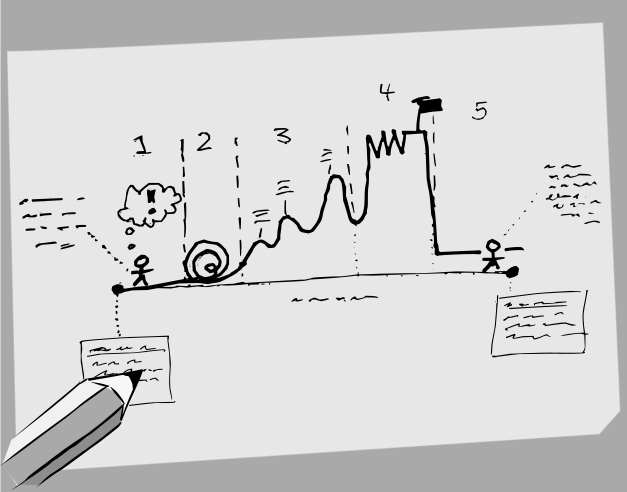
If you want to follow what I do, split your two-dimensional throughline into five equal sections.
Section 1: is the original flat line. Here I note down what is happening to my hero before the action gets started.
Section 2: I add a small spiral. Here I note down what causes the action to start. Something happens that means the hero has to start doing something differently.
Section 3: I draw a roller-coaster of three peaks. These are three challenges that the hero overcomes.
Section 4: is my final peak, marked with spikes and a flag. The spikes represent the final dragon (supreme challenge), and the flag marks the treasure your hero wins.
Section 5: I sweep my pencil down a steep line that returns towards the original throughline. After this fast descent, I continue the line across, parallel and just above the original throughline. This is where the hero returns back to their everyday life, elevated slightly from the original line.
Your shape may be much simpler. It might look like a pyramid, or a ski slope, or a bouncing ball. Is it a steady climb? A rise and fall? A stumble and recovery? A circular return? A sharp descent followed by hard-won renewal? This is your sketch – find a shape that works for you.
Your audience may not see the diagram. But they will feel the shape.
Third Dimension – The Character Depth
It is time to add some depth to the main character.
Without character depth, a story can have a line and a shape and still feel flat. It may make sense but not quite come alive.
Character depth gives a story emotional texture. Here are three tips that will help you add depth. Consider each and add notes at the associated moment along your story arc.
- Note down what is unique about your hero (your stickperson). Unique, in the sense of what makes them distinct: their name, how they look, specific interests, a quirk, etc.
- Add a thought bubble out from your starting hero (stickperson) and draw what they wish for. This might be a powerful yearning (e.g. promotion for everyone on the team) or a whimsical craving (e.g. an excuse for a celebratory drink after work).
- Mark a moment when your hero hesitates. Choose a moment in your story where your hero considers stopping, even contemplates turning back. It can be apathy, it can be fear, it can be confusion, it can be self-doubt, etc.
The task is to add some details. These can often by very minor details. They add flavour and richness (and believability) to your story.
Dimension 4. Time to Practice
If you remember your physics, you will recall that the fourth dimension is time. This reminds you to take the time to practice your story.
Fold up your sheet of paper and put it in your pocket. Then bring it out repeatedly to practice your story. Soon you won’t need to look at the paper at all but having it in your pocket will remind you to keep practicing.
The first time you tell a story, you often discover that the opening is too slow. Or that a detail you thought mattered really does not. Or that the turning point needs more emphasis. Or that you have been so careful with the set-up that you have drained all the blood from it.
Tell it to your dog on the daily walk. Share it with a friend over a drink. Deliver it to a colleague before a meeting. Keep making the time to follow the story arc.
Telling your story helps you find its primary form.
Is there a Fifth Dimension?
There is one more dimension, one that you do not always need to stretch towards, but one worth considering.
This is the dimension of multiple realities!
Your story can be packaged to be passed onto other people with the expectation that they will tell their own version of the story. Their version will morph to their realities. This is not a fault on their part, this is a choice in the very design of your story.
You deliberately help your audience share a version of your story with the aim of amplifying the impact of your story.
Take your original scribbled diagram and create a simplified visual. Turn it into something that can be easily shared with your audience. The modern version might be a QR code to a pdf.
Offer your audience this summary of your story. Help them take the story and pass it forward, amended to their reality.
----
There are many dimensions to a successful business story. Start small: a single clear point. Add a throughline. Craft a story arc that makes sense to you. Add character depth. Take the time to practice. Help others tell their own version of your story.
Each time you want to form a new business story, grab a piece of paper and start with a single mark, then build up the dimensions!
Note: this blog is partially inspired by a great conversation with Lise Kaye-Bell in 2025.
Comments