

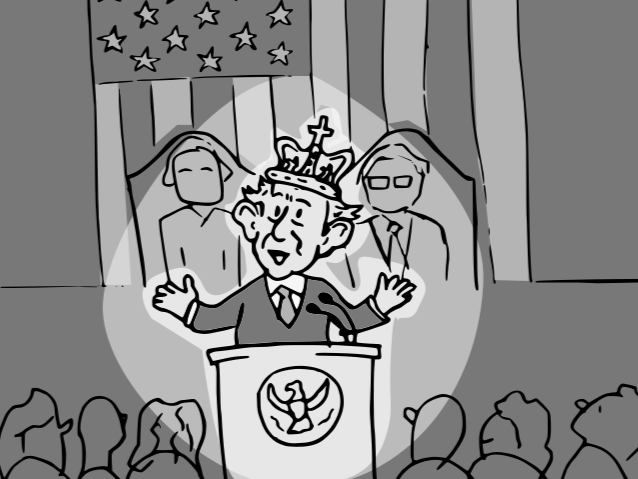
On the 13th May this year, King Charles delivered an important speech at a Joint Meeting of Congress. At this moment the relationship between the UK and the USA was under strain. There were key differences in positions on international policy. Yet, the UK was adamant that it wanted to maintain a positive collaborative relationship and to do so without tilting towards sycophancy.
How did Charles, as a monarch, indeed as the monarch of the country they broke away from 250 years previously, champion collaboration and mutual reliance?
King Charles (with the help of expert speech writers) crafted a speech focussed on the principles of being the Everyman. He acknowledged the differences, but framed each of them as the inevitable part of a still strong mutually beneficial relationship. King Charles stepped into that chamber to present himself not as the embodiment of regal authority, but as a fellow member of a very old, very complicated, and very resilient tribe.
Even a King, my King, knew the value of speaking as an equal.
— — —
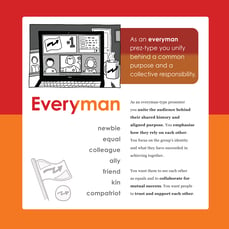
In our book, The Versatile Presenter, we describe twelve different styles of presenting. In our model, King Charles spoke in the Everyman presenter style.

This is how we describe this style in the book. “As an Everyman-type presenter you unite the audience behind their shared history and aligned purpose. You emphasise how they rely on each other. You focus on the group’s identity and what they have succeeded in achieving together.”
This is the core of what King Charles said and the way that he said it. Here is a long section from early in the speech where he lays out his core message. Note: bold emphasis is mine.
“As I look back across the centuries, Mr Speaker, there emerge certain patterns; certain self-evident truths from which we can learn and draw mutual strength. With the Spirit of 1776 in our minds, we can perhaps agree that we do not always agree – at least in the first instance! Indeed, the very principle on which your Congress was founded – no taxation without representation – was at once a fundamental disagreement between us, and at the same time a shared democratic value which you inherited from us. Ours is a partnership born out of dispute, but no less strong for it... So perhaps, in this example, we can discern that our Nations are in fact instinctively like-minded – a product of the common democratic, legal and social traditions in which our governance is rooted to this day.”
The Everyman presenter does not seek to impress, instruct, or inspire from a lofty position above the audience. Instead, they stand alongside them. They remind the group of what they share: a common history, a common purpose, a set of hard-won traditions. They are there to unite, not to lead. To uphold the shared customs that keep both sides secure.
“Whatever our differences, whatever disagreements we may have, we stand united in our commitment to uphold democracy, to protect all our people from harm, and to salute the courage of those who daily risk their lives in the service of our countries.”
The speech is a masterclass in stitching together a shared identity from strands of history, law, language, and blood. He moves through centuries. He explains that Magna Carta is cited in at least 160 Supreme Court cases; that The Declaration of Rights of 1689 is echoed, often verbatim, in the American Bill of Rights of 1791; that the Founding Fathers drew directly on the British Enlightenment. The King wants us to remember that…
“These roots run deep. And they are still vital.”
The effect is to say: we are not separate tribes, we are interconnected tribes. Sometimes the rhetoric of the clan is strong.
“The bond of kinship and identity between America and the United Kingdom is priceless and eternal. It is irreplaceable and unbreakable.”
At other times it is more satisfyingly subtle.
“Today, thousands of U.S. service personnel, defence officials and their families are stationed in the United Kingdom, as British personnel serve with equal pride across thirty American States.”
When speaking in the Everyman style, you do not just speak of mutual connection, you also talk of your reliance on each other. Your responsibilities to each other. You can do this by recalling their past support. How they had your back in your hour of need.
“The first reigning British Sovereign to set foot in America was my Grandfather, King George VI. He visited in 1939 with my beloved Grandmother, Queen Elizabeth The Queen Mother. The forces of Fascism in Europe were on the march, and some time before the United States had joined us in the defence of freedom. Our shared values prevailed.”
However, such reliance should be shared – you include how you have supported them. King Charles reminisced about a time when the UK stood with the USA.
“This year, of course, also marks the 25th anniversary of 9/11. This atrocity was a defining moment for America and your pain and shock were felt around the whole world… We stood with you then. And we stand with you now in solemn remembrance of a day that shall never be forgotten.”
Even when Charles is speaking about geography, he manages to find a way to underline the direct connections between us.
“For millennia, millennia before our nations existed, before any border drawn, the mountains of Scotland and Appalachia were one. A single continuous range forged in the ancient collision of continents.”
When a speaker chooses a style of presenter to embody, there is always a way to bind each element back to the way you want to say it.
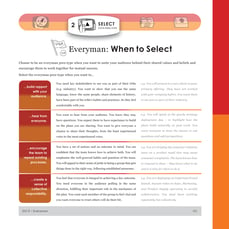
The Versatile Presenter gives you a practical way to do this. It gives you tips and techniques specific to the type of presenter you choose to be. If you want to be as strong an Everyman as King Charles, read the chapter in the book.
----
The Versatile King
The King’s speech is just under half an hour long. This means he has the time and space to embody more than one style of speaking. He could stay solely as the Everyman presenter, but there is great value in brief moments in another style and dramatic energy from a noted shift for a key section.
At moments he switches into a Jester style of presenting – bringing humour. Then near the end of his speech he steps carefully into the Maverick style presenter, where his language shifts from connection and collaboration to something a little spikier.
The Jester King

Periodically a little twinkle appeared in his eyes and he hoppped into being a Jester presenter. Each text in bold below draws easy laughter from the audience. He quoted Wilde.
“And for all of that time, our destinies as Nations have been interlinked. As Oscar Wilde said, “We have really everything in common with America nowadays except, of course, language!”
He referenced quaint old UK traditions.
“As you may know, when I address my own Parliament at Westminster, we still follow an age-old tradition and take a member of Parliament ‘hostage’, holding him or her at Buckingham Palace until I am safely returned. These days, we look after our ‘guest’ rather well – to the point that they often do not want to leave! “
When he returned to the matter of the 250th anniversary of independence, he confidently dropped in a gentle joke.
“This is by no means my first visit to Washington, D.C. – the capital of this great Republic. It is in fact my 20th visit to the United States, and my first as King and Head of the Commonwealth. This is a city which symbolises a period in our shared history, or what Charles Dickens might have called ‘A Tale of Two Georges’…”
This step into the Jester style skilfully relaxes an audience – it lightens the mood. It helps people feel even more warmly towards him and his people.
On the surface this is simply good humour. Notice the precision of the jokes too. A shared language. A reference to a past tempestuous relationship in the UK that has evolved into a harmless ritual within the bedrock of our democracy. Another reference to a tempestuous moment in history with a smile showing that it was all a long time past.
The Jester appears to bring respite from the state language, but is still aimed at the core task: unity and trust.
The Maverick King

When Charles turns to the subject of nature and the environment, something changes. This is one topic where King Charles has always been a more vocal advocate for change. In a speech steeped in our shared history, he still takes the time to share a call for change.
For the first time in the speech he does not unite the audience; instead he warns them. It is a single paragraph, 30 seconds in delivery, yet it is a striking section because of his shift in style.
“Yet, even as we celebrate the beauty that surrounds us, our generation must decide how to address the collapse of critical natural systems… We ignore at our peril the fact that these natural systems provide the foundation for our prosperity and our national security.”
This is not the Everyman. This is the voice of someone who has seen an uncomfortable truth, who believes the cause is greater than any single nation or interest, and who will not look away from it. A call to confront something most in the room would perhaps prefer to sidestep. It is a braver, lonelier register — and it lands differently.
If you watch the speech, his demeanour changes slightly too. As Everyman his every micro movement, his every glance to his audience, is collegiate. As a Maverick speaker he looks disapprovingly at his audience; he almost waggles a disapproving finger.
Closing Section
The theme is friendship, even through times of disagreement, so this is where he ends.
“The story of the United Kingdom and the United States is, at its heart, a story of reconciliation, renewal and remarkable partnership.
“From the bitter divisions of 250 years ago, we forged a friendship that has grown into one of the most consequential Alliances in human history.”
Yes, we still hear the trace echo of the Maverick speaker in some of his last words.
“I pray with all my heart that our Alliance will continue to defend our shared values, with our partners in Europe and the Commonwealth, and across the world, and that we ignore the clarion calls to become ever more inward-looking.”
It is easy to believe that we only have one way of speaking – we choose our particular groove and rely on it every time we stand to speak. If you want to find the versatile presenter within you, our book is designed to hold your hand and guide you through being a more agile communicator. Order The Versatile Presenter from Amazon or directly from our website.
A skilled speaker, a skilled statesman, a King, knows that we can all adapt ourselves to the moment and to the message.
---
Transcript of his speech: https://www.royal.uk/news-and-activity/2026-04-28/the-kings-address-to-the-joint-meeting-of-congress-in-washington
Video of his speech: https://www.youtube.com/watch?v=tCUZWnX8JIM
Comments